
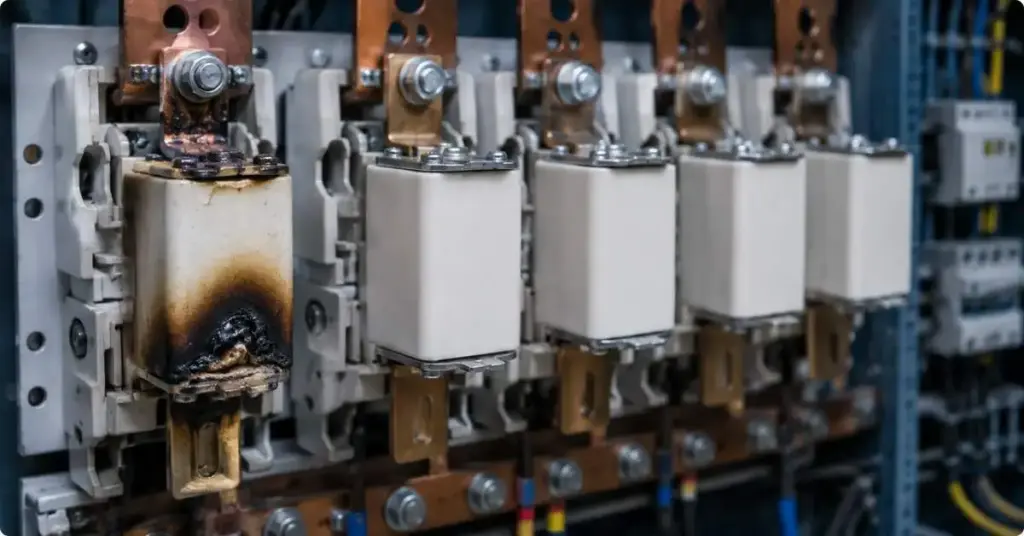
A single NH fuse link failure in an industrial panel can shut down an entire production line — and in many Indian factories, it does, more often than it should. The real problem is that most of these failures are entirely preventable. They are caused not by defective fuses, but by selection mistakes, installation oversights, and environmental neglect that compound over months or years until the fuse fails at the worst possible moment.
Whether you are a panel builder assembling new MCCs, an electrical contractor wiring up a distribution board, or a maintenance engineer trying to figure out why the same fuse keeps blowing on the shop floor, this guide covers the five most common NH fuse link failures seen in Indian industrial installations — and exactly what you can do to prevent each one.
1. Overloading — The Most Common and Most Avoidable Failure
Overloading is, by far, the number one reason NH fuse links fail prematurely in Indian industrial panels. It happens when the continuous load current flowing through the fuse exceeds its rated capacity for extended periods. The fuse element heats beyond its design threshold, and over time, the internal element degrades until it ruptures — sometimes without any short circuit event at all.
Why Overloading Happens So Often in Indian Panels
There are several reasons overloading is so prevalent in Indian industrial setups. First, load growth is often unplanned. A panel originally designed for a 200A load gradually gets burdened with additional machines, auxiliary equipment, or lighting circuits added during expansions, without anyone recalculating the fuse sizing. Second, many installations run motors and compressors at or near full load continuously, especially in textile mills, plastics units, and CNC job shops — environments where duty cycles are far heavier than the “typical” conditions fuse datasheets assume.
Third, ambient temperature plays a critical role that is widely underestimated. NH fuse links are rated at a standard ambient temperature of 40°C. In Indian factory environments — particularly in Coimbatore, Chennai, Ahmedabad, and other industrial belts — panel enclosure temperatures during summer can easily reach 55–65°C. At these temperatures, the effective current-carrying capacity of the fuse drops significantly. A 250A-rated NH fuse operating inside a panel at 60°C ambient might only safely carry 210–220A continuously.
How to Prevent Overloading Failures
The most effective prevention is to apply proper derating factors during panel design. Eaton Bussmann publishes detailed derating curves for their NH fuse links — use them. As a rule of thumb, never load an NH fuse above 80% of its rated current in standard Indian industrial conditions. If panel temperatures regularly exceed 50°C, derate further to 70–75%.
When adding new loads to an existing panel, always recalculate total demand and check whether the installed fuse rating still has adequate headroom. If it does not, upsize the fuse — do not simply “try it and see.” And ensure that panel ventilation is adequate: louvered enclosures, exhaust fans, or air conditioning for critical panels can make a measurable difference in fuse longevity.
2. Corrosion and Environmental Degradation — The Silent Killer
Corrosion is the failure mode that creeps up silently. Unlike overloading, which eventually produces visible heat discolouration or tripping events, corrosion can degrade an NH fuse link internally for months or years before it manifests as a sudden, unexplained failure.
How Indian Conditions Accelerate Corrosion
Indian industrial environments pose particular challenges for fuse link longevity. Coastal installations in cities like Chennai, Mumbai, and Visakhapatnam face salt-laden air that aggressively attacks copper and silver contact surfaces. Chemical process plants, electroplating units, and battery manufacturing facilities expose fuses to acidic or alkaline vapours. Even relatively benign environments in inland cities face challenges from high humidity — Coimbatore and Tirupur textile units, for example, often operate in humidity levels above 80% during monsoon months, which accelerates oxidation of contact surfaces.
The damage manifests in two ways. External corrosion affects the fuse link’s blade contacts, increasing contact resistance and creating localised hotspots. Internal corrosion affects the fuse element itself, altering its melting characteristics. Both can cause the fuse to operate unpredictably — either blowing at currents well below its rating (nuisance tripping) or failing to clear a fault within its rated breaking time (a far more dangerous scenario).
How to Prevent Corrosion-Related Failures
Start with proper IP-rated enclosures. Panels installed in corrosive or humid environments should be IP54 or higher, with sealed cable entries and proper gaskets. For coastal or chemical plant installations, consider panels with anti-corrosion coatings or stainless steel construction.
Apply a thin layer of contact grease (specifically formulated for electrical joints — never petroleum jelly) to fuse link blade contacts during installation. This creates a barrier against moisture and corrosive agents without increasing contact resistance.
Establish a periodic inspection schedule — every six months in harsh environments, annually in standard conditions. During inspection, remove each NH fuse link, visually check for discolouration, pitting, or white/green oxidation deposits on the blades, and check blade contact surfaces with a contact resistance meter. Replace any fuse link showing visible corrosion, even if it has not tripped — its performance characteristics are no longer reliable.
Finally, choose fuse links from reputed manufacturers like Eaton Bussmann that use high-grade silver elements and tin-plated copper blades with superior corrosion resistance. This is one area where the difference between a branded and a local fuse link becomes starkly apparent over a 3–5 year service life.
3. Wrong Utilisation Category Selection — gG vs. aM vs. gTr Confusion
This is a design-stage failure that causes ongoing operational headaches. Selecting the wrong utilisation category for an NH fuse link is surprisingly common, especially among panel builders and contractors who treat all NH fuses as interchangeable “just pick the right amps” devices. They are not.
Understanding the Three Main Utilisation Categories
gG (General Purpose / Full-Range): These fuse links provide overload and short-circuit protection for general distribution circuits — cable protection, busbar feeders, lighting distribution. They respond to the full range of overcurrents, from low-level overloads to high-magnitude short circuits.
aM (Motor Protection / Partial-Range): These are designed specifically for motor circuits. They are built to withstand high inrush currents during motor starting (which can reach 6–8 times the full-load current for DOL starters) without blowing. However, aM fuses only protect against short circuits — they do not provide overload protection. This means aM fuses must always be used in combination with a thermal overload relay.
gTr (Transformer Protection): These fuse links are engineered to handle the high magnetising inrush currents of transformers (which can reach 10–12 times rated current for several cycles) while still providing protection against sustained overloads and short circuits. Using a gG fuse on a transformer circuit leads to nuisance tripping during energisation.
Common Selection Mistakes in Indian Panels
The most frequent mistake is using gG fuses on motor circuits. When a gG fuse is installed in a DOL motor starter circuit, the inrush current during motor starting — perfectly normal and lasting only a few seconds — is enough to partially melt the fuse element. The fuse may not blow immediately, but repeated motor starts cause cumulative thermal fatigue in the element, until the fuse eventually ruptures during a routine start — typically diagnosed as “the fuse just blew for no reason.”
The reverse mistake — using aM fuses on general distribution feeders — is equally dangerous. Because aM fuses do not respond to low-level overloads, a sustained 150% overload on a feeder protected by an aM fuse will not cause the fuse to operate. The cable overheats, insulation degrades, and the risk of fire increases significantly.
How to Prevent Category Selection Errors
The solution is straightforward: match the fuse utilisation category to the circuit type, every time. Use gG for general distribution and cable protection. Use aM for motor circuits, always paired with thermal overload relays. Use gTr for transformer primary protection. Never substitute one for another based solely on current rating.
When specifying NH fuse links for a panel, document the utilisation category alongside the current rating in the bill of materials and on the panel wiring diagram. This ensures that replacement fuses installed during maintenance are the correct type — a common failure point, since maintenance stores often stock only gG fuses “because they are general purpose.”
4. Poor Contact Pressure and Installation Defects
An NH fuse link is only as reliable as the contact between its blade terminals and the fuse base. Poor contact pressure — caused by worn fuse bases, incorrect installation, or the use of mismatched components — creates high-resistance joints that generate heat, accelerate degradation, and can ultimately cause catastrophic failure.
Why Contact Pressure Problems Are So Widespread
In many Indian industrial installations, NH fuse bases see decades of service. Over time, the spring contacts within the fuse base lose their tension due to thermal cycling, repeated fuse replacements, and simple metal fatigue. The result is loose contact between the fuse link blades and the base, creating a high-resistance joint.
The heat generated at a loose contact point creates a vicious cycle: the heat further softens the spring contacts, reducing pressure even more, generating more heat, until the contact area reaches temperatures high enough to melt the blade or the base — often with dramatic results including arcing, smoke, and fire inside the panel.
Another common issue is the use of fuse links and fuse bases from different manufacturers. While NH fuse dimensions are standardised under IEC 60269, there are subtle manufacturing tolerances in blade thickness, contact geometry, and surface finish that can affect the quality of contact. A fuse link that “fits” physically may not make optimal electrical contact.
How to Prevent Contact-Related Failures
Inspect fuse base contacts periodically using a contact resistance meter. The contact resistance between the fuse link blade and the base should be in the low microhm range — typically below 20 µΩ for a properly functioning assembly. Any significant increase over previous readings indicates degrading contacts.
Replace fuse bases that show signs of heat damage — discolouration, melting, or deformed contact springs. Do not attempt to “re-tension” damaged spring contacts; replace the entire base assembly. Modern Eaton Bussmann fuse bases are designed with high-performance spring contacts that maintain consistent pressure over thousands of fuse replacement cycles.
During fuse installation, ensure the fuse link is fully seated in the base with firm, even pressure on both blade contacts. The fuse link should not wobble or move laterally when installed. If it does, the base contacts are worn and need replacement.
Use fuse links and fuse bases from the same manufacturer wherever possible. If you are using Eaton Bussmann NH fuse links, pair them with genuine Eaton Bussmann fuse bases for optimal contact performance and safety.
5. Harmonic Currents — The Modern Industrial Challenge
Harmonic distortion in power systems is an increasingly common cause of unexplained NH fuse link failures in Indian industrial installations. As factories add more variable frequency drives (VFDs), LED lighting systems, UPS units, switched-mode power supplies, and other nonlinear loads, the harmonic content in the electrical supply increases — and fuses bear the consequences.
How Harmonics Cause Fuse Failures
Harmonics increase the RMS current flowing through a fuse without necessarily increasing the fundamental frequency current measured by most standard ammeters and energy meters. A circuit that appears to be drawing 180A on a standard ammeter may actually be carrying 200A or more in true RMS terms when harmonic currents are factored in.
This means the fuse is carrying more current than the panel builder or maintenance team realises. Over time, this additional heating from harmonic currents causes the same kind of thermal degradation as direct overloading — but it is far harder to diagnose because the ammeter reading looks normal.
The problem is particularly acute on circuits feeding VFDs, CNC machines, injection moulding machines, and large UPS systems — all of which are common in Indian industrial setups. The third harmonic is especially problematic in three-phase systems because it is additive in the neutral conductor, which can carry currents exceeding the phase current in severe cases.
How to Prevent Harmonic-Related Fuse Failures
First, measure true RMS current on circuits with significant nonlinear loads. Standard moving-iron or rectifier-type ammeters do not capture harmonic content accurately — use a true RMS clamp meter or power quality analyser to get accurate current readings. You may discover that circuits you thought were operating at 75% fuse capacity are actually at 95% or higher.
Second, factor harmonics into fuse sizing during panel design. For circuits with a total harmonic distortion (THD) above 20%, apply an additional derating factor of 10–15% beyond the normal thermal derating. This means selecting a higher-rated fuse link than the fundamental load current alone would suggest.
Third, consider installing harmonic filters — passive or active — on circuits with heavy nonlinear loads. Reducing the harmonic content not only protects fuses but also improves overall power quality, reduces transformer heating, and lowers electricity costs.
Fourth, pay particular attention to neutral conductors and neutral fuse links in three-phase panels supplying single-phase nonlinear loads. The neutral current in these circuits can be significantly higher than the phase current due to third-harmonic addition. Undersized or under-rated neutral fuse links are a hidden failure risk.
Prevention Checklist: Keep Your NH Fuse Links Running Reliably
Here is a practical summary you can implement right away on your next panel build or maintenance visit:
During Panel Design and Build:
- Apply 80% loading rule: never load an NH fuse above 80% of rated current in Indian conditions
- Apply ambient temperature derating from the manufacturer’s data — not from assumptions
- Match utilisation category to circuit type: gG for distribution, aM for motors (with overload relay), gTr for transformers
- Specify same-manufacturer fuse links and fuse bases for optimal contact
- Account for harmonic currents: use true RMS measurements, add 10–15% derating for THD above 20%
During Maintenance and Inspection:
- Inspect and measure contact resistance every 6–12 months
- Check for visual signs of corrosion, heat damage, or discolouration on blades and bases
- Replace fuse bases with worn or damaged spring contacts — do not attempt repairs
- Verify fuse utilisation category matches the circuit during every replacement
- Measure true RMS current and compare against fuse rating
Environment and Enclosure:
- Use IP54 or higher enclosures in humid, coastal, or chemically aggressive environments
- Ensure adequate panel ventilation or cooling to keep ambient below 50°C
- Apply electrical contact grease to fuse blade contacts in corrosive environments
Why the Right Fuse Link Makes the Difference
Many of these failures are worsened — or even caused — by the use of low-quality, unbranded NH fuse links that do not meet the manufacturing precision and material quality required by IEC 60269. Fuse links with imprecise elements, poor-quality blade plating, and inconsistent breaking capacity introduce unpredictable variables into your panel’s protection system.
Eaton Bussmann NH fuse links are manufactured to exacting standards, with high-purity silver fuse elements, tin-plated copper blades for superior corrosion resistance, and independently verified breaking capacities up to 120kA. Each fuse link delivers predictable, reliable performance across the full range of operating conditions — including the demanding environments typical of Indian industrial installations.
If your panels are experiencing unexplained fuse failures, nuisance tripping, or heat-related damage at fuse points, the combination of correct selection, proper installation, and genuine Eaton Bussmann fuse links will resolve the vast majority of these issues.
Browse the complete range of Eaton Bussmann NH Fuse Links available at Shansen Enterprises →
View NH Fuse Links Catalog
Need help selecting the right NH fuse link for your panel?
WhatsApp us with your requirements — our team will help you choose the correct rating, size, and utilisation category for your application.
About Shansen Enterprises
Shansen Enterprises is an authorised dealer of Eaton Bussmann fuses and industrial electrical products in India. We supply panel builders, electrical contractors, and industrial maintenance teams with genuine, specification-grade components backed by technical support and fast delivery.